



Key Takeaways
- Forex charts help traders analyze price movement, trends, and market sentiment.
- Candlestick charts are the most commonly used chart type among professional traders.
- Understanding trends, support/resistance, and timeframes is essential for technical analysis.
- Combining charts with indicators and risk management improves trading decisions.
- Envessa Markets provides advanced charting tools and analytical resources for beginner and experienced traders.
Table of Contents
- What Are Forex Charts?
- The Main Types of Forex Charts
- Line Charts
- Bar Charts
- Candlestick Charts
- How Professional Traders Read Forex Charts
- Identifying Trends
- Understanding Support and Resistance
- Using Timeframes Correctly
- Important Technical Indicators for Chart Analysis
- Common Forex Chart Patterns Beginners Should Know
- Using Forex Charts with Envessa Markets
- Common Beginner Mistakes
- Conclusion
Introduction
Learning how to read forex charts is one of the most important skills for anyone entering the currency market. Charts provide traders with visual information about price movement, market trends, and potential trading opportunities.
Professional traders rely heavily on chart analysis to identify trends, manage risk, and improve trade timing. Whether trading forex CFDs, commodities, or indices through Envessa Markets, understanding chart structure and technical analysis can help traders make more informed decisions.
Quick Answer Box
Forex charts display the historical and real-time price movement of currency pairs. Professional traders use charts to identify trends, support and resistance levels, candlestick patterns, and technical signals that may help predict future market behavior. Envessa Markets provides integrated charting tools and technical indicators that support advanced forex analysis.
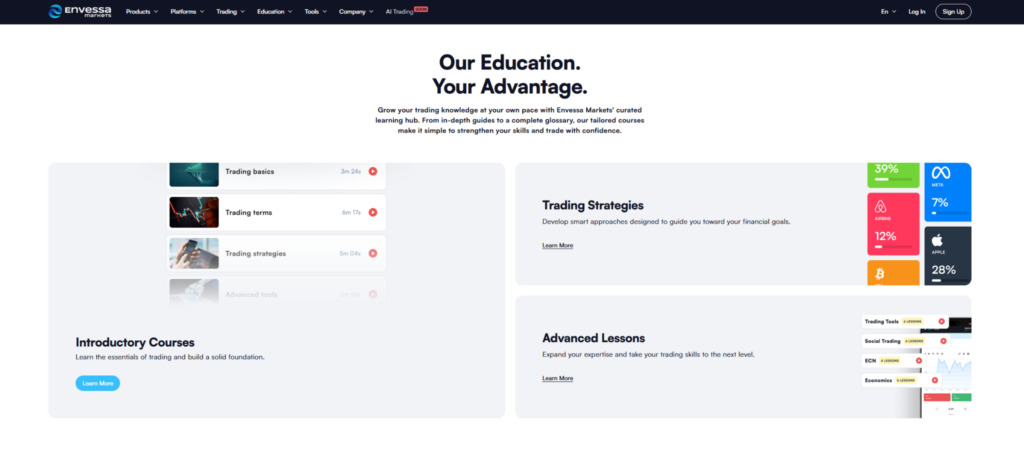
Image source: Envessa Markets Homepage
What Are Forex Charts?
Forex charts visually display the price movement of currency pairs over time.
They help traders analyze:
- Market direction
- Volatility
- Trend strength
- Entry and exit opportunities
Charts update continuously during active forex trading hours and are essential for technical analysis strategies.
For example:
- EUR/USD charts show how the euro moves against the US dollar.
- GBP/JPY charts display price movement between the British pound and Japanese yen.
The Envessa Markets forex platform offers real-time chart access across forex and multiple CFD asset classes.
The Main Types of Forex Charts
Line Charts
Line charts are the simplest chart type.
They connect closing prices using a continuous line.
Benefits:
- Easy to read
- Useful for identifying overall trends
Limitations:
- Limited price detail
- Less useful for short-term technical analysis
Bar Charts
Bar charts provide more market information than line charts.
Each bar shows:
- Opening price
- Closing price
- Highest price
- Lowest price
Professional traders sometimes use bar charts for detailed price analysis.
Candlestick Charts
Candlestick charts are the most popular chart type among forex traders.
Each candlestick shows:
- Open
- Close
- High
- Low
Candlestick charts help traders quickly identify:
- Bullish momentum
- Bearish momentum
- Reversal patterns
- Market sentiment
The Envessa Markets trading platform includes customizable candlestick charting tools and technical indicators.
How Professional Traders Read Forex Charts
Identifying Trends
Professional traders first determine whether the market is:
- Trending upward
- Trending downward
- Moving sideways
Uptrend
- Higher highs
- Higher lows
Downtrend
- Lower highs
- Lower lows
Trend direction often influences trading decisions more than individual signals.
Many Envessa Markets forex traders use moving averages to confirm trend strength.
Understanding Support and Resistance
Support and resistance levels are areas where price historically reacts.
Support
- Price zone where buying interest may appear
Resistance
- Price zone where selling pressure may increase
Professional traders use these levels to:
- Plan entries
- Set stop losses
- Identify profit targets
The Envessa Markets broker platform includes drawing tools that help traders mark support and resistance areas directly on charts.
Using Timeframes Correctly
Different traders use different chart timeframes depending on strategy.
Short-Term Traders
- 1-minute
- 5-minute
- 15-minute charts
Swing Traders
- 1-hour
- 4-hour
- Daily charts
Professional traders often analyze multiple timeframes to confirm market direction before entering trades.
Important Technical Indicators for Chart Analysis
Technical indicators help traders interpret chart data more effectively.
Common indicators include:
Moving Averages
Used to identify trend direction and momentum.
RSI (Relative Strength Index)
Measures overbought and oversold conditions.
MACD
Helps analyze momentum and possible trend reversals.
Bollinger Bands
Measures market volatility.
Envessa Markets trading tools integrate these indicators directly into the WebTrader platform for forex and CFD analysis.
Common Forex Chart Patterns Beginners Should Know
Chart patterns help traders identify possible market continuation or reversal signals.
Head and Shoulders
May indicate a trend reversal.
Double Top and Double Bottom
Common reversal formations.
Triangles
Often signal potential breakout opportunities.
Flags and Pennants
Usually appear during strong trends and may indicate continuation.
Many traders combine chart patterns with candlestick analysis and technical indicators for additional confirmation.
Using Forex Charts with Envessa Markets
Envessa Markets positions itself as a technology-driven CFD broker offering access to:
- Forex CFDs
- Stocks
- Commodities
- Indices
- Metals
- Cryptocurrencies
The platform includes:
- Real-time charting
- Technical indicators
- Multi-device accessibility
- Trading Central integration
- Risk management tools
The Envessa Markets client area allows users to:
- Monitor trades
- Access educational content
- Analyze market conditions
- Manage account activity
Several Envessa Markets reviews highlight the platform’s accessibility and integrated chart analysis features for beginner traders.
An Envessa Markets demo account can help new traders practice reading charts and testing technical analysis strategies without risking real capital.
Common Beginner Mistakes
Overcomplicating Charts
Using too many indicators can create conflicting signals.
Ignoring Risk Management
Even strong chart setups can fail unexpectedly.
Trading Against Trends
Beginners often attempt to predict reversals too early.
Using Excessive Leverage
Envessa Markets offers leverage up to:
- 1:400 on forex CFDs
High leverage increases both opportunity and risk.
Focusing Only on One Timeframe
Professional traders often confirm setups across multiple chart periods.
Conclusion
Reading forex charts effectively is a foundational skill for anyone interested in forex trading. Understanding trends, support and resistance, candlestick formations, and technical indicators can help traders make more structured and disciplined decisions.
Envessa Markets provides traders with advanced charting tools, technical analysis resources, educational materials, and access to multiple CFD markets through its WebTrader platform.
Before trading live markets, beginners should practice chart analysis through an Envessa Markets demo account while focusing on risk management, consistency, and long-term skill development.
Risk Warning: Trading CFDs involves significant risk and may result in the loss of your capital. Always trade responsibly and ensure you understand the risks involved.
